
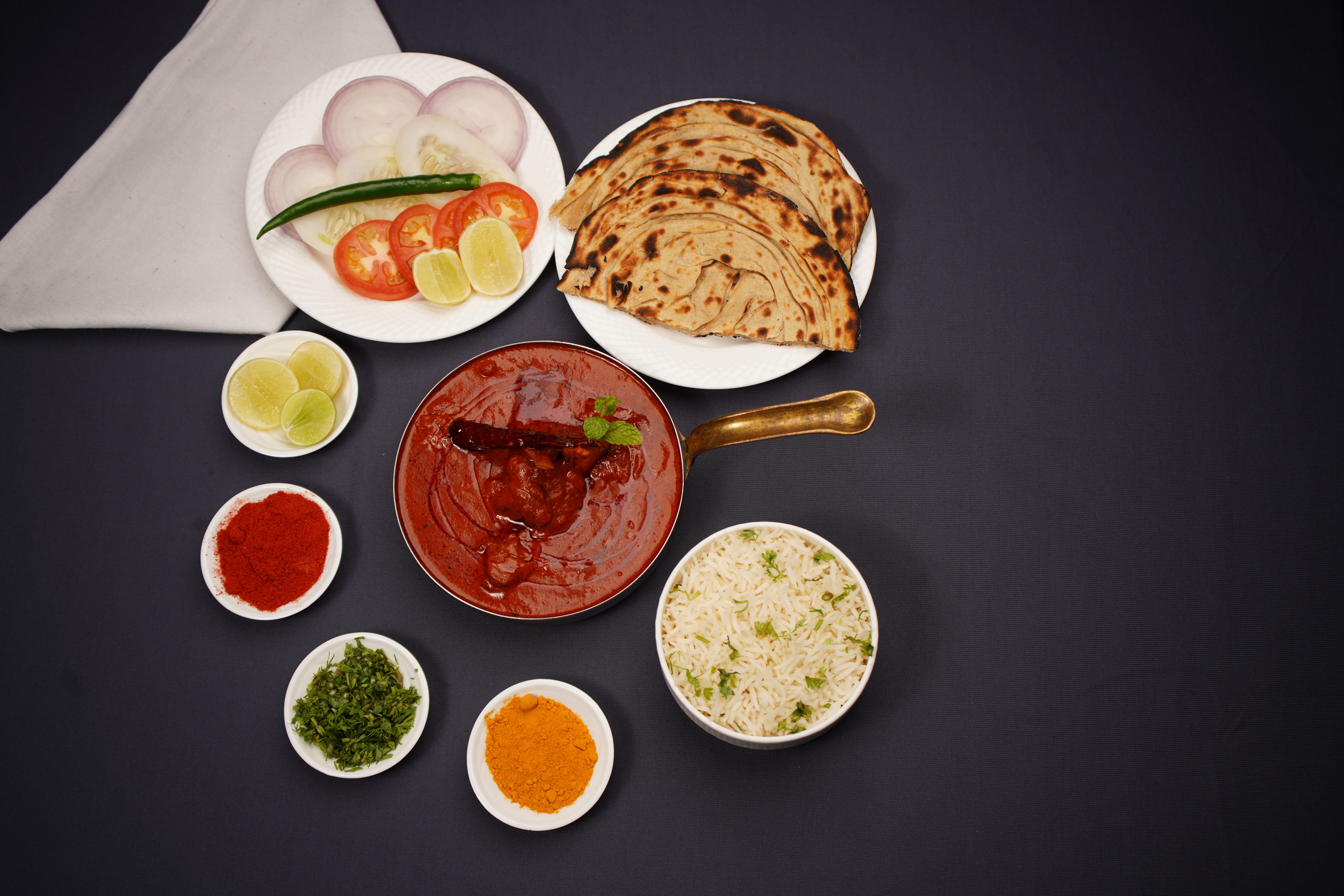
A restaurant menu listing forty dishes is generally cooking from a much smaller number of prepared bases. This is the main reason restaurant food tastes different from the same dishes at home.
Cooking each dish separately is not possible
Every dish on the menu would otherwise require its own onions browned, its own spices bloomed and its own base developed, none of which can happen during service.
A kitchen serving a full room needs a finish measured in minutes, so the long work must already exist when the order arrives.
Preparing a small number of bases in large quantity solves this, and each dish becomes a variation applied to one of them.
The bases divide by colour and body
Most kitchens keep something like a pale base built on onion, cashew or other thickeners, and a darker one built on browned onion and tomato.
A third preparation, often a spinach or a lentil, covers dishes that need a different body altogether.
Between them these cover most of a menu, with the differences between dishes supplied at the finishing stage rather than in the base.
Finishing is where the dishes separate
To order, a portion of base is heated with the specific spices, dairy, dried fenugreek or fresh aromatics that define the named dish.
The main ingredient is added already cooked or cooked quickly, and the whole thing is brought together in a couple of minutes.
Which is why dishes can share a family resemblance across the menu while still being distinguishable, since the top notes differ even though the foundation does not.
The base is built to a different specification
A base made for a service is cooked for far longer than a home cook would cook the equivalent, since it is made once for many portions.
It also carries more fat, which stabilises it during holding, improves the finish, and carries aromatics through the reheat.
Both of these contribute to the specific quality people describe as restaurant-style, which is a consequence of the production system rather than a secret ingredient.
Home cooking works from the other direction
A household cooking one dish builds its base specifically for that dish, so the onions, tomato and spice are chosen to suit it rather than to serve forty dishes.
The result is more distinct between dishes and usually lighter, since there is no need for the fat that a held base requires.
Anyone wanting the restaurant character at home is better served by adopting the method, making a base in quantity and finishing portions of it, than by hunting for a missing spice.