
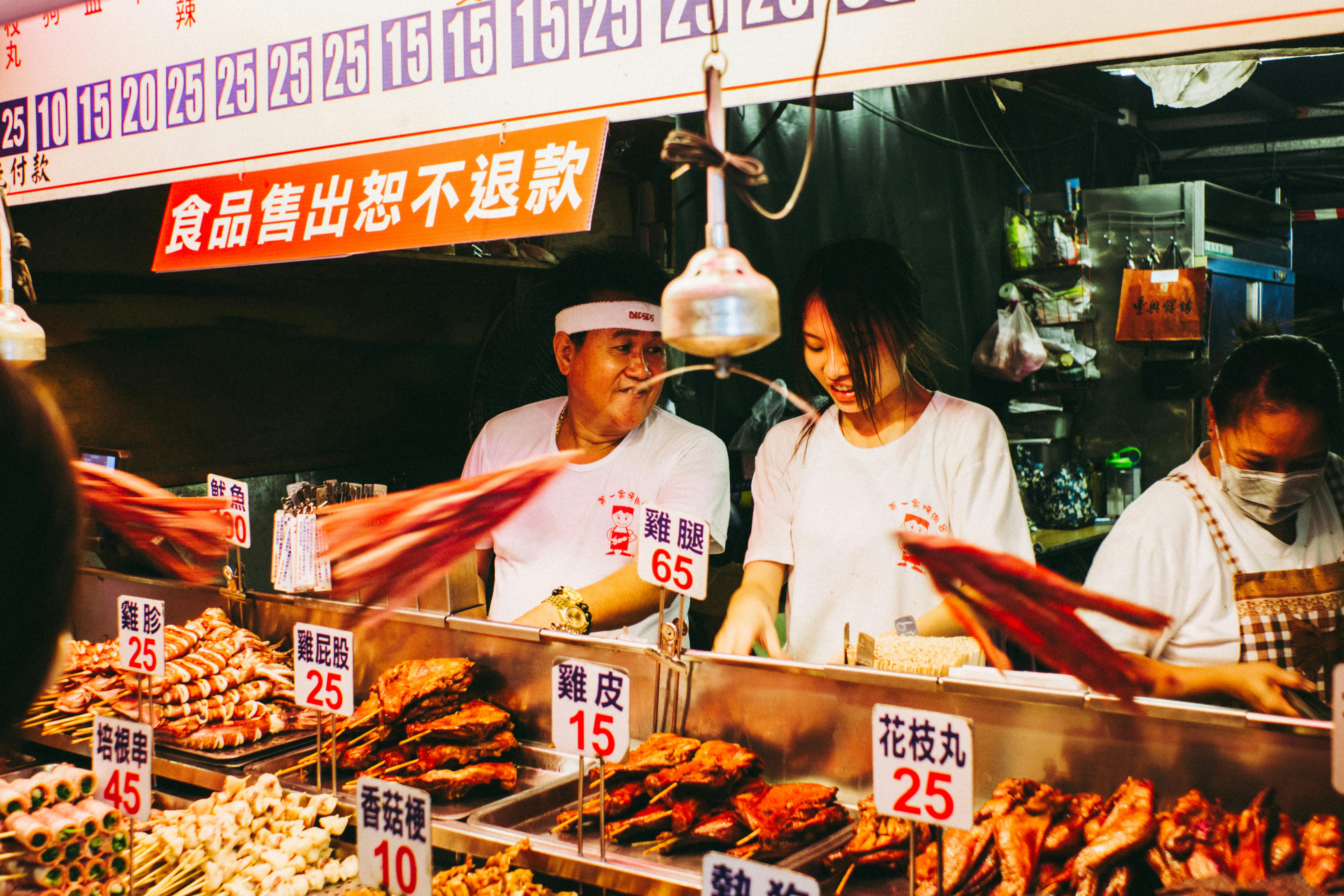
Street food is prepared and sold in conditions with no cold chain, in climates where food spoils quickly. The dishes that survive there are shaped by that constraint.
Frying removes water and sterilises the surface
Deep frying holds food well above the temperature at which bacteria survive and drives moisture out of the outer layer as it cooks.
The result is a dry, hot exterior that is inhospitable to growth for some hours, which is why fried snacks dominate carts in hot places.
The protection weakens once the item cools and reabsorbs moisture from the air, which is why fried street food is best eaten near the fryer.
Acid and salt limit what can grow
Most bacteria responsible for spoilage and illness struggle below a certain acidity, so heavily soured preparations resist growth without any cooling.
Tamarind, citrus, vinegar and fermented bases all serve this purpose alongside their flavour role, which is a large part of why they appear so consistently.
Salt works in parallel by binding water and making it unavailable, which is the same principle behind pickles that sit unrefrigerated for months.
Sugar concentration protects sweets
Syrup-soaked and reduced-milk sweets contain so much dissolved sugar that very little free water remains for microorganisms to use.
That is why such sweets keep for days on an open counter while a fresh dairy preparation would not last an afternoon.
The same logic sets the boundary, since sweets made with fresh cream or without sufficient sugar are the ones that require cold storage.
Turnover does more than any technique
A busy stall sells its entire day's preparation within hours, so nothing sits long enough for the question of storage to arise.
Vendors size their preparation to expected demand for exactly this reason, and running out is a better outcome than holding stock overnight.
Which is why a queue is a reasonable proxy for freshness, and why a quiet stall with a full display warrants more caution than a crowded one.
Water is the weak point
The elements most often implicated in illness are those involving untreated water, including ice, chilled drinks and chutneys thinned with water.
These bypass every protective mechanism above, since they are neither heated, acidified nor concentrated before serving.
Choosing items that were recently hot, and treating water-based additions with more care, addresses most of the practical risk without avoiding street food altogether.